Wednesday, 19 October 2011

Protein Muffins

If you are looking for something different to complement or supplement your protein intake, you might consider the following muffin recipe:

1 cup whole wheat flour
2 scoops strawberry whey protein
1 whole egg
3 egg white
2 baby jars apple, strawberry & banana fruit mix
3/4 cup oatmeal
125ml water
1/2 tsp baking soda
1/4 tsp salt

Directions: combine eggs, fruit from baby jars and water with flour, whey protein, oatmeal, baking soda and salt.  Mix well.  Poor into muffin tin.  Preheat oven to 350 degrees and bake for 17 to 20 minutes or until tops are golden and piercing muffin with toothpick or knife is dry.

Makes 12 servings

per serving (1 muffin): 118 Calories : 2g Fat : 16g Carbohydrates : 8g Protein

These work great for breakfast on the go or as part of a mid morning snack.  You can adjust the ratios to suit your needs.

Thursday, 29 September 2011

Preparatory Phase

Having taken a short break from structured cycling workouts and slowly re-introducing myself with weights in the gym, I am now beginning a six month Preparatory Phase that initially consists of muscle development and low intensity cycling workouts, will lead into on and off the bike strength development and finally into cycling and racing specific workouts.

The break, or as commonly called the Transition Phase, was much needed.  The eight week cycle I put myself through over the summer after my shoulder separation to prepare for the Niagara Classic Road Race was intensive and as I discovered, more than my body was willing to take.  Cycling during this transition phase was enjoyable as the rides contained no structure; simply just going out and riding.  Gym workouts also began during this phase; starting with two sessions a week and increasing to four sessions over a 4 week period.  An assortment of exercises were completed, again no real structure per se, just reintroducing my body and muscles to the effort they would endure over the next 24 weeks.

The Preparatory Phase is my first structured attempt at muscle development so there will be lots to learn during this process.  As part of an annual plan or as commonly known as Periodization, my Preparatory Phase begins with three one month cycles (mesocycles) where each cycle includes four one week microcycles, three of which build from one week to the next and the forth for recovery and adaptation.  Each microcycle will include a three day split weight lifting program, three days of low intensity / moderate mileage cycling with some muscle tension and/or steady state intervals and one day off.

The weight lifting portion includes three workouts that are completed on Monday, Wednesday and Friday and contain four exercises; one upper body pull, one upper body push, one squat or deadlift and one accessory / isolation exercise.  In the first mesocycle, each week begins with heavy weight, low number of repetitions and high number of sets and ends with a light weight, high number of repetitions and low number of sets.  The logic behind this approach is to lift heavy earlier in the week when your muscles are more rested.  As the week progresses, although the weight decreases, the increased repetitions and fatigue on the muscles ensures the workout remains challenging.  For each exercise, a different angle is used.  Upper body pulls for instance might include a chin-up on day 1, a seated row on day 2 and an upright row on day 3.  Likewise, at least one lower body exercise each week will be completed on one leg such as a Bulgarian Split Squat or One Leg Romanian Deadlift as these recruit a lot of stabilizer muscles. These ensure the body is challenged each day while at the same time preventing stress on the joints.

At the completion of each mesoocycle, the workouts are changed, weight and intensity is increased and new exercises are introduced to continue to challenge your mind and muscles.

In the coming posts, I will write about all that I learn throughout this phase.

Tuesday, 6 September 2011

Transitioning Time

As I begin transitioning my training I am once again confronted by my diet.  Having increased my carbohydrate intake in the last five months to meet the energy demands of cycling, with fewer hours on the road, less intensity and more time in the gym lifting weights, my macro nutrient intake and percentages must be adjusted accordingly.  The adjustment can be as challenging as giving up a filthy habit which I must admit, I’ve had to do once or twice already.  For me it is not necessarily the love of carbohydrates, rather it’s more a love of breads and cereals!  Reducing if not eliminating them is hard and challenging.

One misconception a lot of people have when exercising is that they can eat whatever and whenever they want as they’ll just burn off the calories or that they deserve a reward for a good workout and either eat more or indulge in a few sugary treats.  I too have fallen victim to this and at times convince myself that my body needs the extra calories for tomorrows ride.  Before I know it, an evening cup of cereal with a splash of milk becomes a whopping 3 cups of cereal with a half pint of milk.  This gradual increase occurs as the net effect on my weight is not initially apparent and I keep pushing or rather gorging ahead.  Two to three weeks later, a pound or two is gained.  No problem I say to myself… must be water retention.  Five to six weeks later… WHAM… I’ve realized not only have I gained 5lbs, but my body fat percentage has increased by 2%!

My goal over the next 6 months is to increase my upper and lower body strength, power and add muscle.  The addition of muscle will of course aid in my appearance, but more importantly, increase my metabolism and assist with the burning of fat.  To add muscle, it is necessary to increase your caloric intake.  However it is not necessary to increase drastically or put on a ton of weight in the process.  An additional 100 calories per day is sufficient.

I like to keep things simple as I am no gourmet chef.  I also like to eat so the approach I take works best for me.  For one, I eat at least 6 meals and snacks a day every three hours from 7am until 10pm.  I include both protein and carbohydrates sources in each meal.  Each meal will consist of a quality protein source, a serving of vegetables and/or a serving of fruit.  Between meals I drink water but will have a coffee or tea in the morning and sometimes in the evening.  I limit my intake of processed foods; refrain from refined carbohydrates such as white breads, white pastas and white rice (or anything in the ingredients that starts with “enriched”), bakery type desserts such as cakes, cookies, donuts etc and sugary beverages other than 100% fruit or vegetable juice.  Yogurt I will eat as a source of protein and calcium and the odd ice cream as a treat. Carbohydrates in the form of whole wheat / whole grain cereals and breads are consumed at breakfast to replace depleted glycogen stores and as the body will utilize these for energy throughout the day.  A typical day for me would look like the following:

7:00AM Breakfast – 1 cup of plain Oatmeal; slice of 100% Whole Wheat Toast w/ tablespoon of Peanut Butter; Whey Protein Smoothie with a cup of frozen berries; coffee with a single milk and sugar.  Multivitamin and Omega 3-6-9 supplements.

10:00AM Snack – 2 to 3 larges eggs scrambled or as an omelette; an ounce of cheese; ¾ cup of chopped peppers (red, orange and green) and onions; a medium apple

1:00PM Lunch – Salmon steak w/ beets; a half cup of whole long grain rice; yogurt and 100% orange juice

4:00PM Snack – Whey Protein Smoothie with a cup of frozen berries and cup of mixed veggies (not included in the smoothie unless it was a sweet vegetable such as carrot or beet)

7:00Pm Dinner – Chicken breast w/ broccoli and yogurt

10:00PM Snack – Turkey breast slices w/ cheese and an apple

NOTE: the WHEY protein at breakfast addresses my post recovery needs as I generally work out prior.  Foods with a high glycemic index and low in fat aid in the rapid delivery of protein to the muscles.  As my workouts occur before breakfast, I find it challenging to balance this requirement while at the same time, feeling full and satisfied until my mid morning snack.

Sunday, 14 August 2011

Niagara Classic Road Race 2011 - Ontario Cup Road Race #7

My 2011 competitive cycling campaign has come to an end at the 2011 edition of the Niagara Classic held in Pelham, Ontario.  For this final Ontario Cup cycling race, double points were awarded for the top 15 finishers.  After the second accent up Saylor’s Hill, I accepted the fact that my 3rd place overall in the Master 3 Ontario Cup standing going into this race would not stand.  My legs would not respond to the pace of the others up the 2km accent and I completed the race at my own pace.

Overall I am quite happy about my racing performance this year.  I far exceeded my expectations having been away from cycling or any athletic activity for 19 years.  It’s interesting to see that after so many years away from the sport, there are certain races, terrain and situations that continue to suit you better.  Recognizing weaknesses provides me with the desire to work on these over the next 6 months.

I proved to myself that no one is ever Too Fat to Be Fit.  With a conscience effort to eat healthy and exercise, it is possible to return to some form of fitness.  Add some structure and intensity; it too is possible to become competitive which for years I did not think would be possible.


Sunday, 24 July 2011

2011 Ontario Provincial Cycling Championships

Me w/ red helmet behind Matthias Schmidt
The 2011 Ontario Provincial Road Cycling Championships were held on Sunday July 24 in Heidelberg, ON, a small town just north of Waterloo. 8 weeks since separating my shoulder and 5 weeks into riding again, this was my first race back. Realistically I was just hoping to finish today’s Master A race and using it for some decent race miles as it was just over 100km in length. Unlike other races I have participated in which were ability based (Master 1 through to Master 3, where I raced Master 3; the entry level), this race was aged based (Master A – 30 to 39 years old). I would be competing against some of the strongest Master and in some cases Senior level cyclists who elected to race at the Master level in National and Provincial championships. I was looking forward to it as it would be a way to gauge my ability should I obtain the necessary points to upgrade.

Fortunately the heat wave over the last week more or less broke today but there was still considerable humidity. Hydration was going to be a key and I was lucky to have my father on hand to assist in the feed zone. With the race starting at 1:17pm, it was a nice change to leave home at a respectable hour in the morning. However, racing in the heat of the day was going to be a challenge. All my riding and racing to date has been in the early hours of the morning. The race distance was over 40km more than I have raced this year. On the bike food and energy consumption had to be taken into account. I decided to start off with a single bottle of water, a bottle of an electrolyte drink and I would carry a few GU gels. I know they state never to try anything new on race day, but this day would be my first taking gels. It would be more convenient than carrying food.

I arrived just shortly after 11am and had ample time to register and receive my replacement license for today would be the first day I would race under the colours of Impala Bicycles rather than as an Independent. I spoke with a few Master C&D racers who had just finished and got some insight into the race course. The course was described as rolling hills but apparently there were a significant number of false flats. With a high anticipated pace, I suspected these false flats would begin to take their toll on me.

With my preparation complete, I was off to begin my warm-up. With the heat and the hanging humidity, I found it difficult to get an adequate warm-up. The undulating course too did not provide any benefit. While warming up, I discovered my back wheel was a little out of true as it was rubbing the back brake. Fortunately I discovered this before the race and was able to adjust the brake to prevent the rubbing.

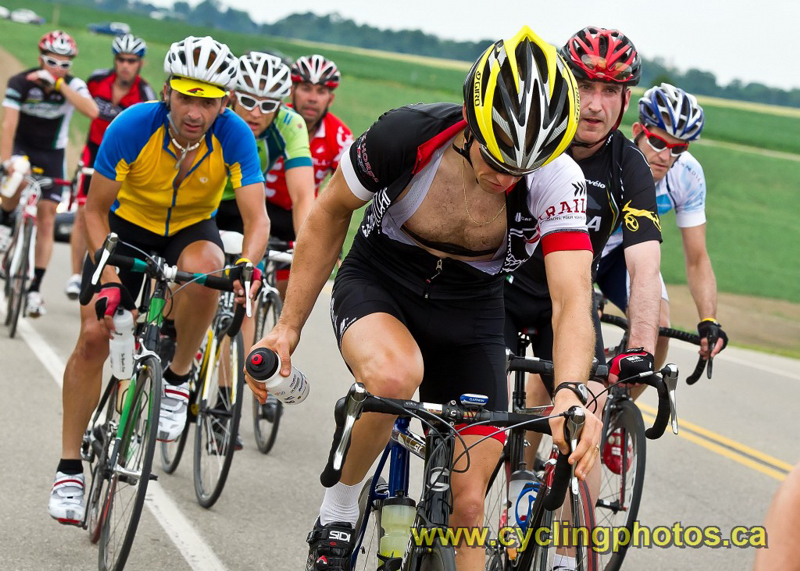
We began the race minutes after the Elite 1&2 and Master B’s. 40+ of us set off on a neutral start from the parking “field” and settled in to a steady yet fast pace. I positioned myself nicely within the middle of the field and moved up as opportunities and space allowed. The first lap I tried to take in as much of the course as I could. By the end of that first lap, I found the most challenging section was just beyond the downhill section after the start/finish line as there were a series of little stinging climbs and false flats.

For the duration of the race, there was not much happening from my viewpoint. There were a few breaks off the front, the most significant having a minute lead, but once the field decided to real them in, they did so swiftly. The race ended in a field sprint with Matthias Schmidt taking a commanding win.

For me, my competition was within the feed zone and a battle to ward off impending leg cramps. I would take my first water at the end of lap 3. An attack or acceleration went off the front and I was gapped on the rise to the finish line. Putting the bottle between my teeth, I jumped to catch on to the rear of the field just as the bottle fell to the road. 14.5km without water but I thought I should be fine as I still had an electrolyte drink on hand. Coming up again towards the feed zone, I was looking for my father to receive much needed water and I could not see him through all those standing within the feed zone. Another 14.5km without water! Into lap #5, I took a second gel and had to down in with the last of my electrolyte drink. I began to feel a cramp coming on in my calves and I tried to stretch them out. I needed water this lap and I positioned myself as close to the front as possible. Coming up to the end of lap #5, it was getting rather congested within the feed zone as others were in need of water as well. I was pushed off my line a few times but finally made my way to the right and got it successfully. Again I was gapped in the feed zone but with the bottle secure, I jumped again to make contact with the end of the field. Just as soon as I made contact and on the decent after the start/finish line, both quads began to cramp. On the rise leading up to the first right hand turn, my hamstrings then seized. Cramping in both the quads and hamstrings became more and more severe and I could no longer pedal. The remaining field passed me by and I signalled to the commissarie following our race that I was done. Once the cramps subsided, I rode easy to the end of the 6th lap and watched the sprint final from the side lines.

Overall I was satisfied with the race yet disappointed I did not finish. I felt I had the legs to go the distance at race pace but I suspect the combination of dehydration, over saturation of electrolytes or lack thereof?? and the demands on the course for my current level of fitness did me in.

Wednesday, 29 June 2011

Hard Knock Life

Well it isn’t that bad but it sure feels that way.  I am into my fourth week of recovery after separating my shoulder in a cycling accident.  The timing you could say couldn’t have been better as I had intended to take a break after my spring racing campaign and focus solely on increasing my training mileage.  However because of the shoulder separation, I have been sidelined and limited to anything that requires physical exertion.  That is… until recently.

A shoulder separation (where the ligament is strained or torn at the Acromioclavicular  joint) generally occurs with blunt force on or around the shoulder area.  In my case, I went heels over head onto the road landing on the rear of my left shoulder resulting in a type 3 separation.  With the separation confirmed, I quickly booked myself into physiotherapy to kick start the recovery process.

The recovery itself and as I am still learning, consists of many stages.

Week 1 through 3 – Self Recovery

Medication for the pain consisted of Extra Strength Motrin/Advil and Tylenol.  Motrin was used in combination with ice to ease the pain and decrease the inflammation.  Tylenol was used to ease the pain.  I took these as directed on the package for the first week.  There after, only as needed.  For ice, I tried to ice three to four times daily for up to 15 minutes.

For the first three weeks, my arm was in a sling to limit movement, ease the weight from my shoulder and position the clavical in line with the acromiom to encourage the ligament to heal.  As my arm would be in a sling, sleeping on my left would be impossible.  For the first two weeks, I slept on a recliner.  After the first week, I began removing the sling at night in favour of elevating and resting my arm on a side pillow.  With my arm in a sling, although driving was technically possible, for safety reasons I choose to take transit to work.

My self recovery also consisted of adequate rest.  For the first week, I did very little and spent a considerable amount of time on the couch.  I had taken a few days off work to get more x-rays taken and attend a few physio sessions.  Brief excursions were taken to the local Dairy Queen for burgers, fries and/or onion rings.  My moral in the first week was pretty low so yes… I did indulge but just a little!

Week1 through 3 – Physiotherapy

The day following the accident, I went to see my GP and asked for a requisition for additional x-rays and physiotherapy.  I wanted the additional x-rays as the originals taken at the hospital did not include any weight bearing pictures.  I wanted to know the severity of the separation and the holding a weight would identify the displacement of the clavical.  I also booked myself in for physio.

Until I saw the orthopaedic doctor and to learn whether surgery was required, physiotherapy involved ultrasound, laser, electrotherapy and taping.  The ultrasound, laser and electrotherapy were done to encourage healing and removing bruising.  The taping was done to push the clavical down, positioning it closer to the acromiom to accelerate the healing of the ligament.  With my arm in a sling, it was important to keep my fingers, wrist and elbow mobile by going through a full range of motion.  I generally did this with my arm supported by a pillow.  By the end of the second week, I began subtle arm pendulum exercises and increasing the range of motion in my shoulder as pain would allow.  I also performed assisted arm raises while lying down to the point where pain was felt.

Week 3 – Physiotherapy

Into week three I began some resistance exercises using a band (green) and a cable machine at my local gym.  Not entirely sure of the effective resistance/weight of the band, but at the gym I am lifting 10lbs without too much pain.  The range of motion is limited and only within the degree pain is not felt.

Week 4 – Physiotherapy

Into week 4, the pain has subsided except when exerting pressure towards the outside of my shoulder.  For instance, if making a fist with your left hand and pushing it into your right hand, pain is felt on the left side of the shoulder.  I completed my last physio session as my physiotherapist considered my range of motion was very good and that I was self motivated to complete the required strengthening exercises.

So the recovery process has been going well.  All in all, 75 percent of the recovery has been completed in 25 percent of the recovery period.  I can expect another 3 to 4 months until I am completely recovered but I expect some lingering side effects.

More updates to come...

Sunday, 22 May 2011

Nith River Road Race 2011 - Ontario Cup #4


Nith River Road Race 2011 - 2nd Master 3
 Patience was the order of the day today.  After being a little overzealous last week in the final at Bike the Bruce, today I was going to change my tactic and let the final play out.  The tactic worked out in the end.
The day began very early, woke up at 3am to begin my journey to Wellsley, Ontario and little town east of Kitchener/Waterloo.  Fortunately, the temperature on this May long weekend was on our side with a projected high of 16 degrees.  Rain and thunderstorms were called for later in the afternoon but there was a possibility of rain in the morning.
I arrived at Wellsley ahead of schedule.  The 2 ½ hour drive was just shy of 2 hours and it gave me plenty of time to drive and review the 16.4km course.  I was a little apprehensive of this race was I was told it was a rolling course with little to no flats.  Although my racing and progression have been going well, continuous hill efforts over 64kms left me worried.  Driving the course, I was reassured that my concerns were nothing to worry about.  If anything, the course suited my style.  The final especially was in my favour as it was somewhat technical with a few sweeping turns and undulating terrain with a slight downhill to the finish.  In my mind, I knew this race was for me!
With the registration open at 7am for our 8:30am start, there was ample opportunity to get ready which was a nice change from the previous few races.  My dilemma was the temperature.  It was cool enough to warrant a long sleeve jersey yet warm enough to forgo it all together.  If the humidity increased, I may find myself overheating yet if it rained, I would be cold.  In the end, I decided to wear the long sleeve jersey as it has a full length zipper on the front that could be unzipped to provide some needed circulation.
As I was warming up on the rollers, my legs felt tired and heavy.  It wasn’t a surprise as on Friday I assisted with my son’s Track & Field meet at school and was responsible for raking and measuring at the standing long jump competition.  What you don’t take into account when volunteering for such an event is the exertion required squatting up and down all day to take measurements.  I added some additional higher cadence intervals in an attempt to loosen them up.
By 8:15am, we were summoned to the line by the race commissarie.  The race would start from the parking lot and be neutralized until we reached Gerber Road.  With the race beginning downhill, I had a feeling the race would begin at a considerable pace.  I made sure I was towards the front.

Nith River Road Race - Course Map

Nith River Road Race - Course Profile

Nith River - Main Peloton
With the race now underway, it did not take long for the attacks to begin.  A single cyclist from Vitess went off the front in what I would consider a doomed attempt.  Although the winds were not a strong as last week, a cross wind would be felt on the majority of the course.  The peleton kept him within easy reach.  Into the second lap, a second cyclist launched an attack to bridge up to the lone Vitess cyclist.  Now with two up the road, if they cooperated, there’d be a chance they would make something of their efforts.  Obviously I was not the only one to think that and shortly, the two were soon caught.  All other breakaway attempts throughout the race were quickly neutralized which suited me well.
Mid way through the second lap my legs were again very tired and heavy just as Jeff Murphy (Team Bike-Fit) and Nick Schwertfeger (Newmarket Eagles Cycling Club) began pushing the pace.  Although I was never in any concern during the race, I could just follow.  I spent more time hydrating myself and spinning the pedals uphill to keep the legs loose and roll along in bigger gears when going downhill.  It seemed to help as into the third lap, I was beginning to feel better.
Mid way through the third lap, the anticipated rain really began to fall.  It had been spitting earlier.  Making our way down Regional Road 107 there’s a descent with a right hand turn at the base taking us onto Perth Line.  As the roads were now as slippery as ice, one cyclist slid out on the turn which alerted us all to the likelihood of more crashes.  For the remainder of the race, more caution was taken.
Into the final lap, the pace remained constant and the jostling for position began along Perth Line.  An attack was made up the left of the road and over the yellow line by Edmond Mellina (Lapdogs Cycling Club) resulting in his disqualification by the race commissaire.  A few others drifted across the yellow line but this was more a result of the switching that was taken place as positions in the peleton were being fought for.  At this point I was sitting mid way through the peleton on the left.  I had expected on the hairpin corner leading onto Gerber Road, there’d be some crashes and I wanted to ensure I was well clear of them.  In the final along Gerber Road, the yellow line rule would not apply allowing us the full use of the road.  Riding on the left provided me with ample space to set up for my sprint.  As I mentioned earlier, I was going to let the final play out and not take any risks or initiative.  That tactic worked in my favour as the sprint started well in advance of the finish line.  I was positioned well, again nicely sheltered from the crosswind and while still seated, raised my cadence and speed and quickly made ground within the peleton.  With the finish line in sight in what seemed to be less than a hundred meters, I began my sprint.  I felt as I was able to effortlessly overtake everyone and as I threw my bike at the line, with the front wheel actually coming off the ground, looking to my right I knew it was close.  Jamie Saavedra (Independent) would go on to claim first with me coming in second by less than three inches!


Nith River Road Race - Master 3 Final


Nith River Road Race - Master 3 Final
  Overall I couldn’t have been happier.  With the initial reservations about the race and course, the tiredness and heaviness I was experiencing before and during the race, and the tactic which I followed to the end, it was a great race.  If my calculations are correct, I am leading the standings in the Master 3 – Ontario Cup Standings with my 7th at Calabogie, 2nd at Springbank and 2nd here at Nith River.

Master 3 Men Results - 65.6 km - Average Speed 37.5 km/h

1 SAAVEDRA, Jaime   INDEPENDENT                 01:45:01 
2 CUMMINGS, Killian INDEPENDENT                 st.
3 PITTS, Martin     RACER SPORTIF/MATTAMY HOMES st.


Complete Results click here