1 cup quick cooking oats
1 scoop (30g) strawberry protein powder
1 egg
3 egg white
whisk all ingredients in a bowl. Pour onto a lightly misted (with olive oil) non-stick pan and cook like regular pancakes
Monday, 14 November 2011

Sunday, 30 October 2011
Eating for Life
I am often asked by those who have not seen me in a few years what I did to lose all the weight. Initially I took offense and would often ask them, "Why... did you think I was fat before?" "No", they would say; "Just… er, bigger!” they would embarrassingly add. Soon I became to realize just how far I had come with my weight loss and how I might be able to help others that want to lose weight or have struggled with weight loss in the past. Fortunately I am not one of those people who had tried every conceived weight loss program available, but I did follow a few programs that in the long run, would not allow me to manage my weight effectively.
Initially I was sold on the low carbohydrate approach as advocated by Atkins. After considerable research, I forged ahead for three months on the program losing 30lbs in the process but the net effect was a lack of sustainable energy once I started exercising. Additionally, limiting myself to the carbohydrates I could consume; notably vegetables, legumes, nuts and berries; made it very difficult to continue. I soon lost my motivation and fell back into my previous way of eating. A little over a year later, all the weight I had lost was back.
With my latest attempt, a little less than two years ago, I was prepared to go the low calorie approach. As the months went by, I was again shedding the pounds. However in time, the weight loss stopped likely as a result of inadequate food intake, increase in lean muscle mass and/or my body getting use to the exercise and unable to adapt further.
After months with no significant change, I began to research more into why I had hit a plateau. What I learned was food intake is a lot like water intake. Drink an adequate amount of water and your body sheds stored water weight. Eat an adequate amount of “sensible” food and your body sheds stored fat weight. If you limit the amount of water consumed, your body will retain water as a precaution. Likewise if you limit the amount of food consumed, your body will retain its fat stores also as a precaution. Give your body both water and food and watch the weight melt away! Now of course this an oversimplified statement as there are a number of variables involved but this is what I observed during the period in which my weight loss had hit a plateau and I began following the approach described below while exercising at a higher intensity.
1. Create an account on Calorie Count and begin logging your food intake without making any significant changes to your diet. This will give you an idea of the quality of your diet and quantity of your calories.
What was most surprising to me was how off I was with my diet. For the exercise, duration and intensity I was performing, I should have been eating approximately 2,600 calories per day. In reality, I was lucky to get 1,400 to 1,600 calories per day.
2. Take your body measurements (neck, chest, waist, biceps, quads) every week or two to gauge your progress. The scale is fine and convenient but it is not a true representation as your overall weight will fluctuate (water, lean muscle mass, hormones etc.). If you have a scale that reports on body fat, it is better than a scale alone.
3. Calculate your daily caloric expenditure. To loose weight and up to 1lb a week, consume 500 less calories a day. Theoretically, a 500 calorie reduction equates to 3500 calories per week or the equivalent of 1lb of fat. In reality, you will find your weight loss will fluctuate. Some weeks you will loose more than 1lb and some weeks you may stop loosing or even gain weight. Do not be alarmed. Rely more on how clothes feel and body measurements than to the scale. If you are doing any strength exercises, remember the volume of lean muscle mass pound for pound is less than fat.
4. If you want to reach a specific goal weight, calculate it here. Keep in mind to loose weight, you must eat. Drastic caloric deduction will do you more harm than good as your body will go into starvation mode and store food intake as fat. YOU MUST EAT TO LOOSE WEIGHT! Drastic caloric reductions are generally reserved for the obese or those who have a considerable amount of weight to loose. They are also monitored by doctors. Typically those that reduce their calories drastically, when returning to normal eating habit, gain all the weight back.
5. Purchase a scale to weigh your food portions. This keeps things as accurate as possible. If making a meal which combines ingredients such as a casserole, weigh and track each ingredient added to calculate the total calories. Then weigh your portion size to get an approximate calorie count.
6. With your daily caloric expenditure calculated, divide the calories consumed into the following 6 meals:
Some also advocate eating more calories earlier in the day and less in the evening. There’s some sense to this as your body requires the energy early to fuel your body for the day. You can change the percentages above but I would still recommend the 6 meals (or 5 at the least).
7. Your macro-nutrient ratio (Fat, Protein, and Carb) should be based on your activity level. The more active you are, the more carbohydrates you will require.
8. Try to balance your nutrient intake at each meal or at the very least, consume protein with carbohydrates and when possible, consume vegetables first, protein second and remaining carbohydrates last.
9. Drink fluids! Eight 8oz of fluid a day should be your target. Your urine should be a pale yellow and odourless. If not, you are dehydrated and retaining water. Fluid intake does not have to be limited to water, 100% fruit and vegetable juices will also work but be mindful of the caloric expense.
10. Follow the Canada Food Guide or your own region's food guide for recommended servings
11. Low to moderate exercise will burn more fat (up to 80% of your energy will come from fat stores) however you will have to exercise longer to loose fat. Moderate to high intensity (HI) exercise will burn more carbohydrates (up to 80%) but fat is still burned and will continue to burn after exercise (known as the after burn effect). HI exercises are completed in shorter durations. Recommend low intensity and gradually increasing the intensity as your body and will allow.
12. Change things up every once in a while as your body will get use to the food and the exercise. By changing things up, it confuses your body and avoids weight loss and exercise adaptation plateaus.
13. Shop the outer isle at the grocery store. There you will find vegetables, fruit, dairy, bread and meat. Limit or eliminate the amount of processed food and refrain from eating refined carbohydrates as these spikes your insulin levels and may contribute to over eating. This includes any carbohydrates including the words enriched in the ingredients (e.g. enriched white floor, enriched wheat flour etc.). Stick to wholesome carbohydrates found in breads and vegetables.
Outcome... in the 6 months following this approach, I broke through my plateau and shed an additional 14lbs of fat and dropped from 172lbs to 158lbs.
Initially I was sold on the low carbohydrate approach as advocated by Atkins. After considerable research, I forged ahead for three months on the program losing 30lbs in the process but the net effect was a lack of sustainable energy once I started exercising. Additionally, limiting myself to the carbohydrates I could consume; notably vegetables, legumes, nuts and berries; made it very difficult to continue. I soon lost my motivation and fell back into my previous way of eating. A little over a year later, all the weight I had lost was back.
With my latest attempt, a little less than two years ago, I was prepared to go the low calorie approach. As the months went by, I was again shedding the pounds. However in time, the weight loss stopped likely as a result of inadequate food intake, increase in lean muscle mass and/or my body getting use to the exercise and unable to adapt further.
After months with no significant change, I began to research more into why I had hit a plateau. What I learned was food intake is a lot like water intake. Drink an adequate amount of water and your body sheds stored water weight. Eat an adequate amount of “sensible” food and your body sheds stored fat weight. If you limit the amount of water consumed, your body will retain water as a precaution. Likewise if you limit the amount of food consumed, your body will retain its fat stores also as a precaution. Give your body both water and food and watch the weight melt away! Now of course this an oversimplified statement as there are a number of variables involved but this is what I observed during the period in which my weight loss had hit a plateau and I began following the approach described below while exercising at a higher intensity.
1. Create an account on Calorie Count and begin logging your food intake without making any significant changes to your diet. This will give you an idea of the quality of your diet and quantity of your calories.
What was most surprising to me was how off I was with my diet. For the exercise, duration and intensity I was performing, I should have been eating approximately 2,600 calories per day. In reality, I was lucky to get 1,400 to 1,600 calories per day.
2. Take your body measurements (neck, chest, waist, biceps, quads) every week or two to gauge your progress. The scale is fine and convenient but it is not a true representation as your overall weight will fluctuate (water, lean muscle mass, hormones etc.). If you have a scale that reports on body fat, it is better than a scale alone.
3. Calculate your daily caloric expenditure. To loose weight and up to 1lb a week, consume 500 less calories a day. Theoretically, a 500 calorie reduction equates to 3500 calories per week or the equivalent of 1lb of fat. In reality, you will find your weight loss will fluctuate. Some weeks you will loose more than 1lb and some weeks you may stop loosing or even gain weight. Do not be alarmed. Rely more on how clothes feel and body measurements than to the scale. If you are doing any strength exercises, remember the volume of lean muscle mass pound for pound is less than fat.
4. If you want to reach a specific goal weight, calculate it here. Keep in mind to loose weight, you must eat. Drastic caloric deduction will do you more harm than good as your body will go into starvation mode and store food intake as fat. YOU MUST EAT TO LOOSE WEIGHT! Drastic caloric reductions are generally reserved for the obese or those who have a considerable amount of weight to loose. They are also monitored by doctors. Typically those that reduce their calories drastically, when returning to normal eating habit, gain all the weight back.
5. Purchase a scale to weigh your food portions. This keeps things as accurate as possible. If making a meal which combines ingredients such as a casserole, weigh and track each ingredient added to calculate the total calories. Then weigh your portion size to get an approximate calorie count.
6. With your daily caloric expenditure calculated, divide the calories consumed into the following 6 meals:
- Breakfast - 25% of total calories
- Mid morning snack - 8.3% of total calories
- Lunch - 25% of total calories
- Mid afternoon snack - 8.3% of total calories
- Dinner - 25% of total calories
- Evening snack - 8.3% of total calories
Some also advocate eating more calories earlier in the day and less in the evening. There’s some sense to this as your body requires the energy early to fuel your body for the day. You can change the percentages above but I would still recommend the 6 meals (or 5 at the least).
7. Your macro-nutrient ratio (Fat, Protein, and Carb) should be based on your activity level. The more active you are, the more carbohydrates you will require.
- If exercising (weights, cardio - treadmill jogging brisk walking cycling etc.) use F-20% P-30% C-50%
- If exercising extreme (running cycling hard intervals etc.) use F-20% P-15% C-65%
- To maintain weight use F-20% P-20% C-60% w/o caloric reduction
- Fat (unsaturated fats in fish, oils, nuts)
- Protein (lean meat, fish, nuts, eggs, quinoa etc.)
- Carbohydrates (100% Whole Wheat breads, 100% Whole Wheat pastas and 100% Whole Grain rice, fruit, vegetables etc.). Eliminate refined carbohydrates found in white bread, white pastas and white rice.
8. Try to balance your nutrient intake at each meal or at the very least, consume protein with carbohydrates and when possible, consume vegetables first, protein second and remaining carbohydrates last.
9. Drink fluids! Eight 8oz of fluid a day should be your target. Your urine should be a pale yellow and odourless. If not, you are dehydrated and retaining water. Fluid intake does not have to be limited to water, 100% fruit and vegetable juices will also work but be mindful of the caloric expense.
10. Follow the Canada Food Guide or your own region's food guide for recommended servings
11. Low to moderate exercise will burn more fat (up to 80% of your energy will come from fat stores) however you will have to exercise longer to loose fat. Moderate to high intensity (HI) exercise will burn more carbohydrates (up to 80%) but fat is still burned and will continue to burn after exercise (known as the after burn effect). HI exercises are completed in shorter durations. Recommend low intensity and gradually increasing the intensity as your body and will allow.
12. Change things up every once in a while as your body will get use to the food and the exercise. By changing things up, it confuses your body and avoids weight loss and exercise adaptation plateaus.
13. Shop the outer isle at the grocery store. There you will find vegetables, fruit, dairy, bread and meat. Limit or eliminate the amount of processed food and refrain from eating refined carbohydrates as these spikes your insulin levels and may contribute to over eating. This includes any carbohydrates including the words enriched in the ingredients (e.g. enriched white floor, enriched wheat flour etc.). Stick to wholesome carbohydrates found in breads and vegetables.
Outcome... in the 6 months following this approach, I broke through my plateau and shed an additional 14lbs of fat and dropped from 172lbs to 158lbs.
Wednesday, 19 October 2011
Protein Muffins

1 cup whole wheat flour
2 scoops strawberry whey protein
1 whole egg
3 egg white
2 baby jars apple, strawberry & banana fruit mix
3/4 cup oatmeal
125ml water
1/2 tsp baking soda
1/4 tsp salt
Directions: combine eggs, fruit from baby jars and water with flour, whey protein, oatmeal, baking soda and salt. Mix well. Poor into muffin tin. Preheat oven to 350 degrees and bake for 17 to 20 minutes or until tops are golden and piercing muffin with toothpick or knife is dry.
Makes 12 servings
per serving (1 muffin): 118 Calories : 2g Fat : 16g Carbohydrates : 8g Protein
These work great for breakfast on the go or as part of a mid morning snack. You can adjust the ratios to suit your needs.
Thursday, 29 September 2011
Preparatory Phase
Having taken a short break from structured cycling workouts and slowly re-introducing myself with weights in the gym, I am now beginning a six month Preparatory Phase that initially consists of muscle development and low intensity cycling workouts, will lead into on and off the bike strength development and finally into cycling and racing specific workouts.
The break, or as commonly called the Transition Phase, was much needed. The eight week cycle I put myself through over the summer after my shoulder separation to prepare for the Niagara Classic Road Race was intensive and as I discovered, more than my body was willing to take. Cycling during this transition phase was enjoyable as the rides contained no structure; simply just going out and riding. Gym workouts also began during this phase; starting with two sessions a week and increasing to four sessions over a 4 week period. An assortment of exercises were completed, again no real structure per se, just reintroducing my body and muscles to the effort they would endure over the next 24 weeks.
The Preparatory Phase is my first structured attempt at muscle development so there will be lots to learn during this process. As part of an annual plan or as commonly known as Periodization, my Preparatory Phase begins with three one month cycles (mesocycles) where each cycle includes four one week microcycles, three of which build from one week to the next and the forth for recovery and adaptation. Each microcycle will include a three day split weight lifting program, three days of low intensity / moderate mileage cycling with some muscle tension and/or steady state intervals and one day off.
The weight lifting portion includes three workouts that are completed on Monday, Wednesday and Friday and contain four exercises; one upper body pull, one upper body push, one squat or deadlift and one accessory / isolation exercise. In the first mesocycle, each week begins with heavy weight, low number of repetitions and high number of sets and ends with a light weight, high number of repetitions and low number of sets. The logic behind this approach is to lift heavy earlier in the week when your muscles are more rested. As the week progresses, although the weight decreases, the increased repetitions and fatigue on the muscles ensures the workout remains challenging. For each exercise, a different angle is used. Upper body pulls for instance might include a chin-up on day 1, a seated row on day 2 and an upright row on day 3. Likewise, at least one lower body exercise each week will be completed on one leg such as a Bulgarian Split Squat or One Leg Romanian Deadlift as these recruit a lot of stabilizer muscles. These ensure the body is challenged each day while at the same time preventing stress on the joints.
At the completion of each mesoocycle, the workouts are changed, weight and intensity is increased and new exercises are introduced to continue to challenge your mind and muscles.


In the coming posts, I will write about all that I learn throughout this phase.
Tuesday, 6 September 2011
Transitioning Time

One misconception a lot of people have when exercising is that they can eat whatever and whenever they want as they’ll just burn off the calories or that they deserve a reward for a good workout and either eat more or indulge in a few sugary treats. I too have fallen victim to this and at times convince myself that my body needs the extra calories for tomorrows ride. Before I know it, an evening cup of cereal with a splash of milk becomes a whopping 3 cups of cereal with a half pint of milk. This gradual increase occurs as the net effect on my weight is not initially apparent and I keep pushing or rather gorging ahead. Two to three weeks later, a pound or two is gained. No problem I say to myself… must be water retention. Five to six weeks later… WHAM… I’ve realized not only have I gained 5lbs, but my body fat percentage has increased by 2%!
My goal over the next 6 months is to increase my upper and lower body strength, power and add muscle. The addition of muscle will of course aid in my appearance, but more importantly, increase my metabolism and assist with the burning of fat. To add muscle, it is necessary to increase your caloric intake. However it is not necessary to increase drastically or put on a ton of weight in the process. An additional 100 calories per day is sufficient.
I like to keep things simple as I am no gourmet chef. I also like to eat so the approach I take works best for me. For one, I eat at least 6 meals and snacks a day every three hours from 7am until 10pm. I include both protein and carbohydrates sources in each meal. Each meal will consist of a quality protein source, a serving of vegetables and/or a serving of fruit. Between meals I drink water but will have a coffee or tea in the morning and sometimes in the evening. I limit my intake of processed foods; refrain from refined carbohydrates such as white breads, white pastas and white rice (or anything in the ingredients that starts with “enriched”), bakery type desserts such as cakes, cookies, donuts etc and sugary beverages other than 100% fruit or vegetable juice. Yogurt I will eat as a source of protein and calcium and the odd ice cream as a treat. Carbohydrates in the form of whole wheat / whole grain cereals and breads are consumed at breakfast to replace depleted glycogen stores and as the body will utilize these for energy throughout the day. A typical day for me would look like the following:
7:00AM Breakfast – 1 cup of plain Oatmeal; slice of 100% Whole Wheat Toast w/ tablespoon of Peanut Butter; Whey Protein Smoothie with a cup of frozen berries; coffee with a single milk and sugar. Multivitamin and Omega 3-6-9 supplements.
10:00AM Snack – 2 to 3 larges eggs scrambled or as an omelette; an ounce of cheese; ¾ cup of chopped peppers (red, orange and green) and onions; a medium apple
1:00PM Lunch – Salmon steak w/ beets; a half cup of whole long grain rice; yogurt and 100% orange juice
4:00PM Snack – Whey Protein Smoothie with a cup of frozen berries and cup of mixed veggies (not included in the smoothie unless it was a sweet vegetable such as carrot or beet)
7:00Pm Dinner – Chicken breast w/ broccoli and yogurt
10:00PM Snack – Turkey breast slices w/ cheese and an apple
NOTE: the WHEY protein at breakfast addresses my post recovery needs as I generally work out prior. Foods with a high glycemic index and low in fat aid in the rapid delivery of protein to the muscles. As my workouts occur before breakfast, I find it challenging to balance this requirement while at the same time, feeling full and satisfied until my mid morning snack.
Sunday, 14 August 2011
Niagara Classic Road Race 2011 - Ontario Cup Road Race #7

Overall I am quite happy about my racing performance this year. I far exceeded my expectations having been away from cycling or any athletic activity for 19 years. It’s interesting to see that after so many years away from the sport, there are certain races, terrain and situations that continue to suit you better. Recognizing weaknesses provides me with the desire to work on these over the next 6 months.
I proved to myself that no one is ever Too Fat to Be Fit. With a conscience effort to eat healthy and exercise, it is possible to return to some form of fitness. Add some structure and intensity; it too is possible to become competitive which for years I did not think would be possible.


Sunday, 24 July 2011
2011 Ontario Provincial Cycling Championships
 |
| Me w/ red helmet behind Matthias Schmidt |
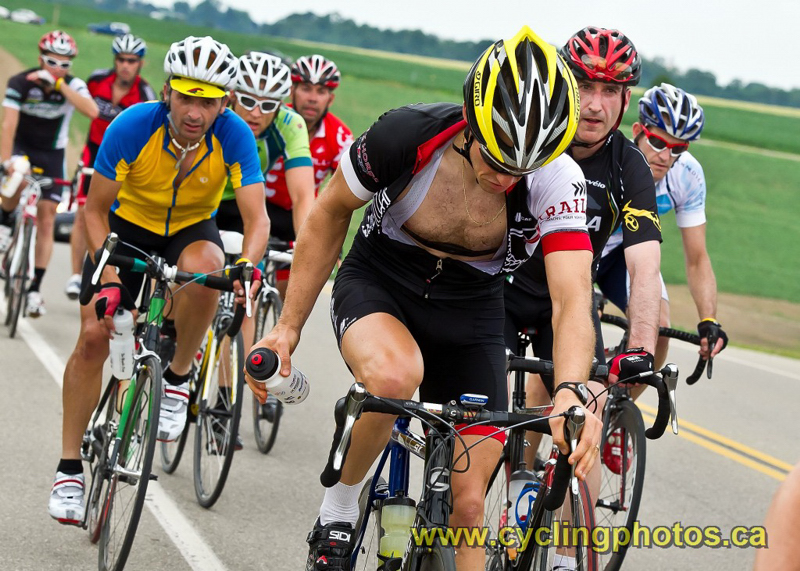
The 2011 Ontario Provincial Road Cycling Championships were held on Sunday July 24 in Heidelberg, ON, a small town just north of Waterloo. 8 weeks since separating my shoulder and 5 weeks into riding again, this was my first race back. Realistically I was just hoping to finish today’s Master A race and using it for some decent race miles as it was just over 100km in length. Unlike other races I have participated in which were ability based (Master 1 through to Master 3, where I raced Master 3; the entry level), this race was aged based (Master A – 30 to 39 years old). I would be competing against some of the strongest Master and in some cases Senior level cyclists who elected to race at the Master level in National and Provincial championships. I was looking forward to it as it would be a way to gauge my ability should I obtain the necessary points to upgrade.
Fortunately the heat wave over the last week more or less broke today but there was still considerable humidity. Hydration was going to be a key and I was lucky to have my father on hand to assist in the feed zone. With the race starting at 1:17pm, it was a nice change to leave home at a respectable hour in the morning. However, racing in the heat of the day was going to be a challenge. All my riding and racing to date has been in the early hours of the morning. The race distance was over 40km more than I have raced this year. On the bike food and energy consumption had to be taken into account. I decided to start off with a single bottle of water, a bottle of an electrolyte drink and I would carry a few GU gels. I know they state never to try anything new on race day, but this day would be my first taking gels. It would be more convenient than carrying food.
I arrived just shortly after 11am and had ample time to register and receive my replacement license for today would be the first day I would race under the colours of Impala Bicycles rather than as an Independent. I spoke with a few Master C&D racers who had just finished and got some insight into the race course. The course was described as rolling hills but apparently there were a significant number of false flats. With a high anticipated pace, I suspected these false flats would begin to take their toll on me.

With my preparation complete, I was off to begin my warm-up. With the heat and the hanging humidity, I found it difficult to get an adequate warm-up. The undulating course too did not provide any benefit. While warming up, I discovered my back wheel was a little out of true as it was rubbing the back brake. Fortunately I discovered this before the race and was able to adjust the brake to prevent the rubbing.
We began the race minutes after the Elite 1&2 and Master B’s. 40+ of us set off on a neutral start from the parking “field” and settled in to a steady yet fast pace. I positioned myself nicely within the middle of the field and moved up as opportunities and space allowed. The first lap I tried to take in as much of the course as I could. By the end of that first lap, I found the most challenging section was just beyond the downhill section after the start/finish line as there were a series of little stinging climbs and false flats.
For the duration of the race, there was not much happening from my viewpoint. There were a few breaks off the front, the most significant having a minute lead, but once the field decided to real them in, they did so swiftly. The race ended in a field sprint with Matthias Schmidt taking a commanding win.
For me, my competition was within the feed zone and a battle to ward off impending leg cramps. I would take my first water at the end of lap 3. An attack or acceleration went off the front and I was gapped on the rise to the finish line. Putting the bottle between my teeth, I jumped to catch on to the rear of the field just as the bottle fell to the road. 14.5km without water but I thought I should be fine as I still had an electrolyte drink on hand. Coming up again towards the feed zone, I was looking for my father to receive much needed water and I could not see him through all those standing within the feed zone. Another 14.5km without water! Into lap #5, I took a second gel and had to down in with the last of my electrolyte drink. I began to feel a cramp coming on in my calves and I tried to stretch them out. I needed water this lap and I positioned myself as close to the front as possible. Coming up to the end of lap #5, it was getting rather congested within the feed zone as others were in need of water as well. I was pushed off my line a few times but finally made my way to the right and got it successfully. Again I was gapped in the feed zone but with the bottle secure, I jumped again to make contact with the end of the field. Just as soon as I made contact and on the decent after the start/finish line, both quads began to cramp. On the rise leading up to the first right hand turn, my hamstrings then seized. Cramping in both the quads and hamstrings became more and more severe and I could no longer pedal. The remaining field passed me by and I signalled to the commissarie following our race that I was done. Once the cramps subsided, I rode easy to the end of the 6th lap and watched the sprint final from the side lines.
Overall I was satisfied with the race yet disappointed I did not finish. I felt I had the legs to go the distance at race pace but I suspect the combination of dehydration, over saturation of electrolytes or lack thereof?? and the demands on the course for my current level of fitness did me in.
Subscribe to:
Posts (Atom)